Dressing the soldier
A 3D scan of a jacket looks perfect from across the room and falls apart up close. How we get our soldiers' uniforms ready for the game.
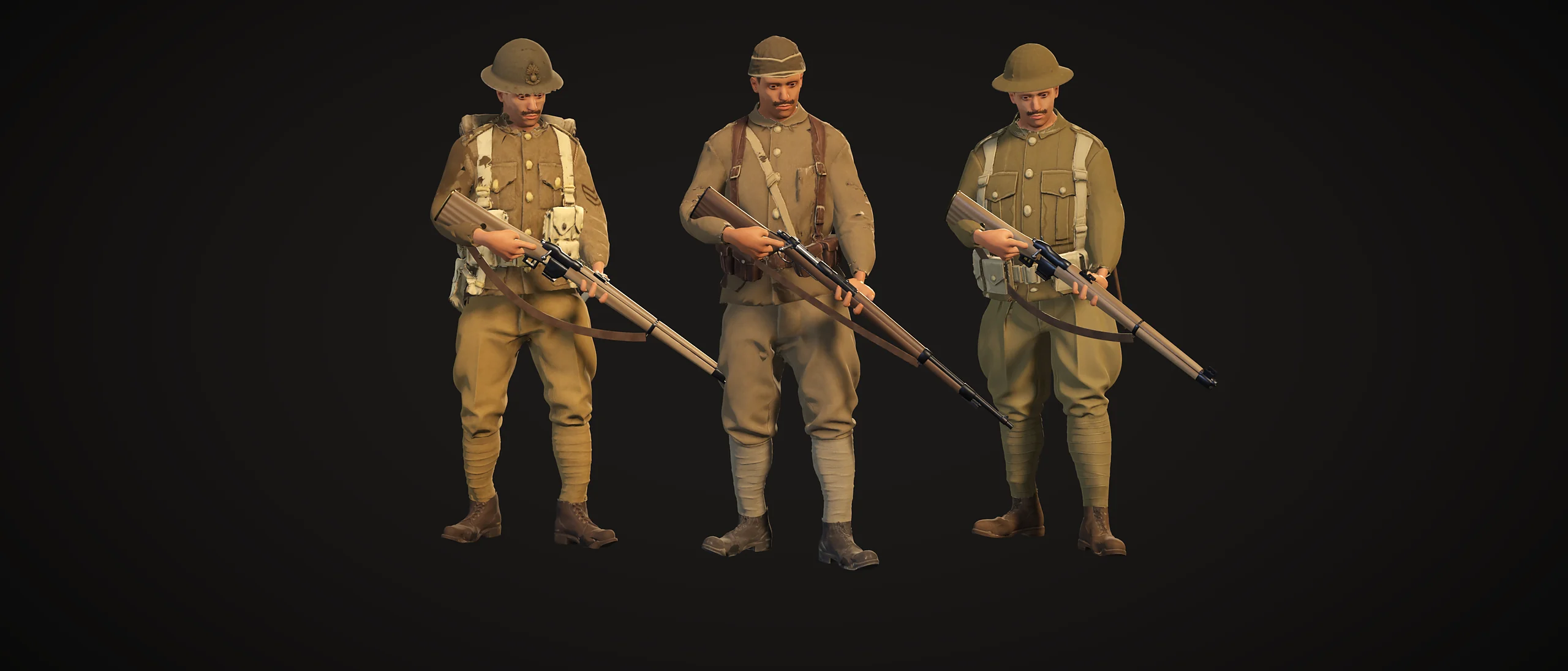
Every uniform in Tabya starts as a scan: a jacket, a pair of trousers, a cap. From across the room they look perfect. Come closer and things change.
Two layers of cloth, one shell
The scan gives the jacket’s outer cloth and its inner lining as two layers fused together, a few millimetres apart. On a soldier who moves, the lining pushes out through the cloth. Our first attempt decided which layer every piece of the jacket belonged to, one piece at a time. The result was a jacket with hundreds of small holes, skin showing through.
The fix was simple: every piece decides by asking its neighbours. If the cloth around it is the outer layer, so is it. Now the two layers part along one clean line in every fold.
Hems, cuffs and edges
Four more problems were hiding behind the first. Hems cut along the ragged edge of the scan. A repair step that took the opening of the skirt for a small hole and closed it. Weights that turned the hem into a saw blade as the soldier walked. And a smoothing pass that pulled every edge inward. We found each one by looking at the jacket after every step.
The result is uniforms that keep their shape from collar to puttees. And we gave both sides of the line the same care: the Ottoman infantryman and the Lancashire Fusilier went through the same hands.